Michelangelo AI API Framework
The Michelangelo AI API Framework abstracts Kubernetes CRDs through a gRPC API server. It is the control plane component that the ma CLI, UI, worker, and SDK all talk to. This guide covers the architecture of that component and how its parts fit together for operators deploying or maintaining Michelangelo AI.
Audience: Platform operators and contributors who need to understand how the API layer is structured.
Prerequisites: Familiarity with Kubernetes CRDs, gRPC, and the Michelangelo AI control plane (see Platform Setup).
Architecture
Michelangelo AI defines the APIs using Protobuf as the IDL and the clients like UI, CLI and SDK can access the API via gRPC or HTTP/JSON. Michelangelo AI will support three SDK bindings by default including Python, Golang and Java. Any other language bindings supported by gRPC should work as well.
For detailed Michelangelo AI API definition, see the protobuf definitions in proto/.
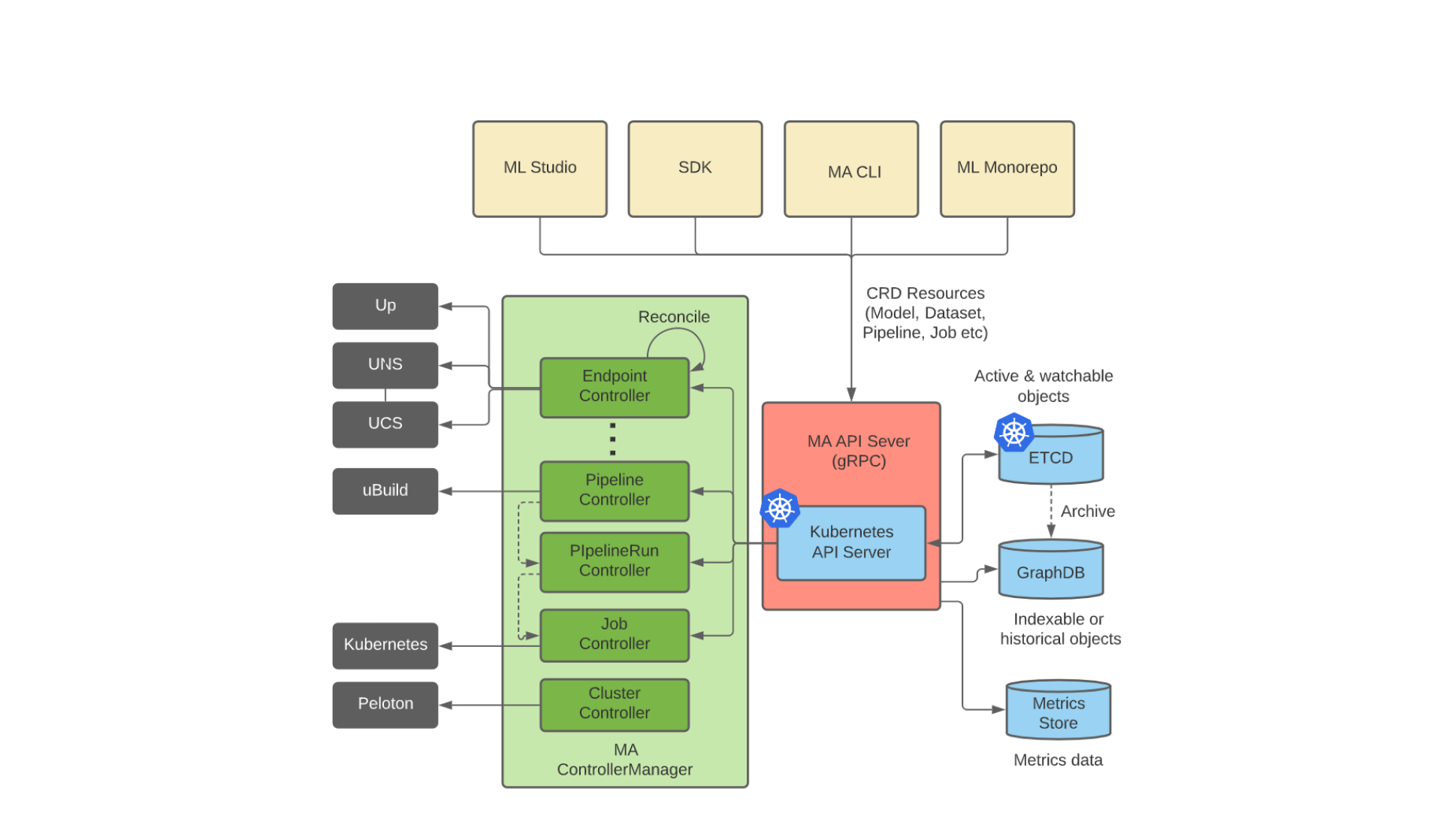
Figure below shows the high-level architecture of Michelangelo AI API framework that consists of the following components:
API Servers
Kubernetes API Server: A REST service that provides the standard methods for each CRD type (API resource type). Controllers monitor the creations / modifications of the CRD objects through the Kubernetes API server. Michelangelo AI users cannot directly call Kubernetes API server. Instead, they have to use Michelangelo AI API server (gRPC) or Michelangelo AI CLI(ma) to use Michelangelo AI APIs.
Michelangelo AI API Server: A gRPC server. For standard declarative API resources, Michelangelo AI API server is a gRPC to REST proxy. The APIs that do not fit into the declarative design are implemented in the Michelangelo AI API server such as Search APIs.
Kubernetes API server and MA API server will be packaged in the same docker container. Both k8s API server and MA API server are stateless. There can be multiple instances for high availability or scalability.
ETCD
ETCD is a strongly consistent key-value store that supports lock, leader election, and watching changes.
All the API resources (CRD objects) are stored in a global ETCD cluster. With API Hooks, API developers may store some of the API resource data into other storage systems (e.g. mysql, S3), while keeping the metadata in ETCD.
Controller Manager
Each controller monitors one API resource type. It’s a controller’s job to ensure that, for any given object, the actual state of the world matches the desired state (specification) in the object.
Currently, all the Michelangelo AI controllers are in a single process, i.e. Michelangelo AI Controller Manager. There will be multiple controller manager instances deployed into different availability zones for high availability. But at any time there is only one instance acting as the leader and others will be the followers.
Controller Manager uses ETCD to do the leader election (through
Kubernetes API server). Controller Manager is based on the Kubernetes open-source
framework, i.e. controller-runtime.
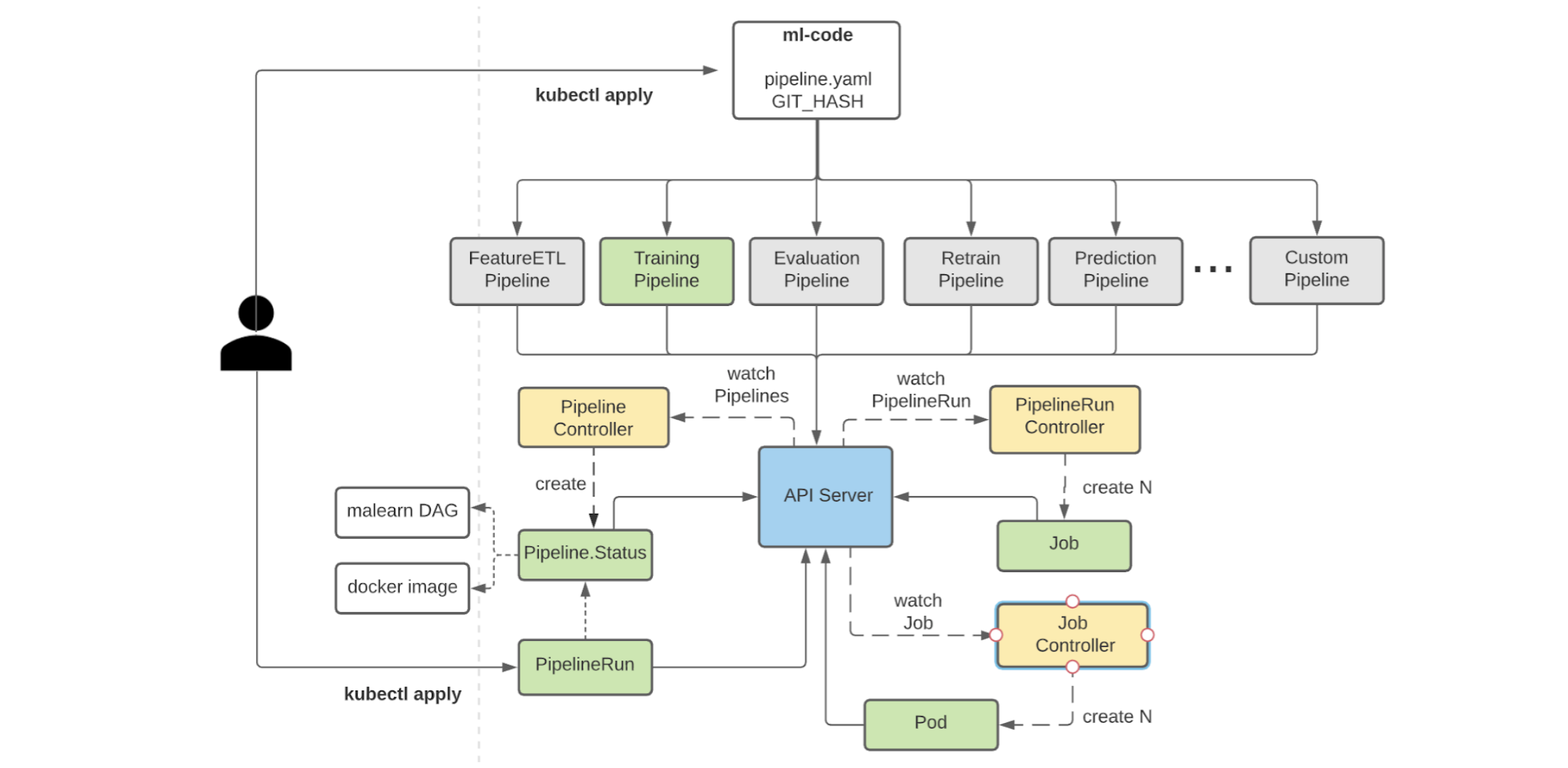
Figure below shows how different ML pipelines can be managed and executed using the Michelangelo AI API Framework.